
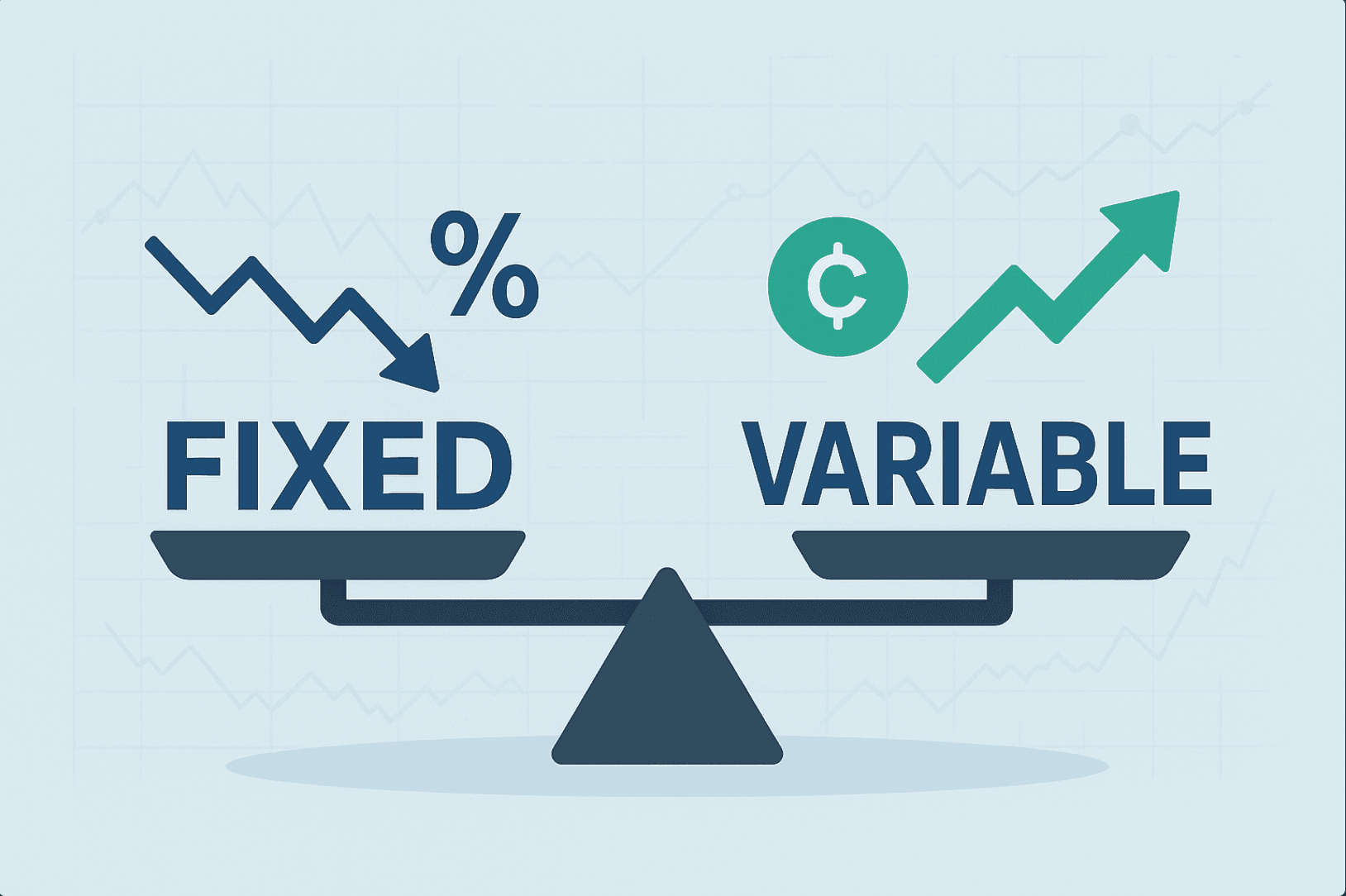
Fixed Rate Mortgage
Your interest rate stays the same for the entire mortgage term, providing predictable monthly payments.
Variable Rate Mortgage
Your interest rate fluctuates with the Bank of Canada's prime rate, potentially saving money when rates fall.
Side-by-Side Comparison
| Feature | Fixed Rate | Variable Rate |
|---|---|---|
| Interest Rate | Stays the same for entire term | Changes with Bank of Canada rate |
| Monthly Payments | Consistent and predictable | Can increase or decrease |
| Penalty to Break | Higher penalty (IRD calculation) | 3 months interest only |
| Rate Discount | Lower discount from prime | Higher discount from prime |
| Protection from Rate Increases | Full protection | No protection |
When to Choose Each Option
Rising Rate Environment
When interest rates are expected to increase
Fixed Rate:
Locks in current rate, protects from increases
Variable Rate:
Payments will increase as rates rise
Recommendation:
Fixed rate is generally better
Falling Rate Environment
When interest rates are expected to decrease
Fixed Rate:
Predictable payments
Variable Rate:
Benefits from rate decreases immediately
Recommendation:
Variable rate often performs better
Stable Rate Environment
When rates are expected to remain steady
Fixed Rate:
Peace of mind with consistent payments
Variable Rate:
May get better rate with variable discount
Recommendation:
Depends on personal preference and risk tolerance
Historical Perspective
What History Tells Us
Long-term trend: Variable rates have historically outperformed fixed rates over longer periods (10+ years) because they typically start lower and benefit from rate cuts during economic downturns.
Short-term volatility: In periods of rising rates (like 2022-2023), fixed rates provide better protection and peace of mind, even if they end up costing more than the initial variable rate.
Risk tolerance matters: The "best" choice depends on your financial situation, risk tolerance, and how comfortable you are with payment fluctuations.
Decision Framework
Choose Fixed Rate If:
- • You prefer predictable monthly payments
- • You're on a tight budget with little room for payment increases
- • Interest rates are low and expected to rise
- • You plan to stay in the home for the full mortgage term
- • You're risk-averse and value peace of mind
Choose Variable Rate If:
- • You can handle payment fluctuations
- • You have financial flexibility to absorb rate increases
- • Interest rates are high and expected to fall
- • You might need to break your mortgage early
- • You're comfortable with some financial uncertainty for potential savings
Compare Both Fixed and Variable Rates
See current rates for both options and make an informed decision based on your situation.
Compare Mortgage Rates